EU alert: 72% of online gambling revenue sits outside regulation
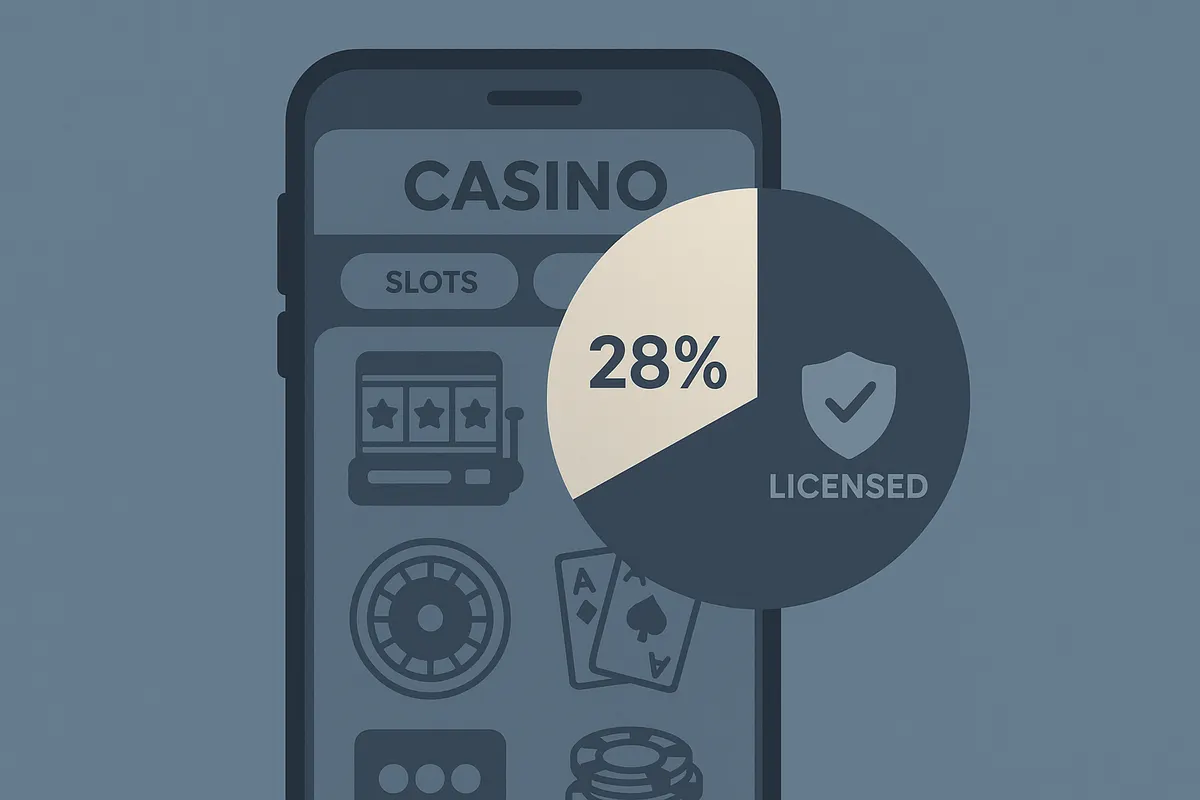
Unregulated online gambling is not a fringe corner of the internet full of obviously broken websites. Across the European Union it is the majority of the market. A new EU-27 analysis puts unregulated online gambling at 72% of all online gambling revenue, which means the sites operating outside local rules now take in more money than the licensed ones do.
The figure comes from “Online Gambling 2024–2025: EU 27 Europe”, produced by Gaming Compliance International for the Campaign for Fairer Gambling. The numbers behind the headline:
- Unregulated online gross gaming revenue (GGR) reached EUR 91.6 billion in 2025, up from EUR 52.6 billion in 2023 — a 74% rise in two years.
- That EUR 91.6 billion is 72% of a European online gambling market valued at EUR 128 billion.
- In 2025, 121 million Europeans were exposed to online gambling content, and 88 million saw content from unregulated operators.
- Among consumers who actively engaged with online betting content, 91% of what they encountered promoted the unregulated sector.
GGR is what operators keep after paying out winnings, so this is money retained by companies working outside the licensing, tax and supervision regime of the country where the player actually sits. The report’s sharpest point is about marketing rather than betting: the enforcement gap opens before any money changes hands. By the time a player deposits, the choice was already shaped by advertising that regulators never approved.
One honest clarification the headline hides. “Unregulated” here means unregulated locally. A large share of that EUR 91.6 billion belongs to companies holding a licence issued somewhere — just not in the jurisdiction serving the player. That distinction matters a lot when you are the one trying to get a withdrawal paid.
What makes online gambling “unregulated”?
An online casino is unregulated when it accepts your money without holding a valid licence from an authority that supervises play in your market. That covers three different situations, and they carry different levels of risk.
No valid gaming licence at all
Some sites hold nothing. Others display a licence that has lapsed, been suspended, or was issued to a company with no connection to the brand you are playing on. A badge in the footer is a graphic, not proof. If the licence number does not appear in the regulator’s public register, treat the site as unlicensed.
Licensed elsewhere, supervised nowhere near you
This is the grey area that produces most of the 72%. An operator licensed in one jurisdiction accepts players from countries where it holds no permission, often in markets that have no local online casino licensing system to apply for. The licence is real; its protections were written for a different market, and the regulator that issued it has no duty to a player it never intended to cover.
Sidestepping compliance obligations
Licensed operators carry running costs: independent game testing, segregated player funds, identity and source-of-funds checks, advertising restrictions, mandatory deposit and session limits, self-exclusion registers, tax. Operators that avoid those obligations can offer bigger bonuses, looser verification and faster signups. That gap in cost is exactly why unregulated marketing dominates what players see.
Regulated vs unregulated gambling: what actually changes for you
The difference is not the games. Many unregulated sites run the same slots and live dealer tables as licensed ones. The difference is what happens when something goes wrong.
| Area | Licensed operator | Unregulated operator |
|---|---|---|
| Player funds | Often required to be held separately from company funds, with reporting to the regulator | No requirement; balances sit in company accounts |
| Game fairness | RNG and RTP verified by approved independent test labs | Self-declared; no third party checks the maths |
| Complaints | Internal process plus an external dispute body or regulator you can escalate to | Support chat is the end of the line |
| Responsible gambling | Deposit, loss and session limits, cool-off, self-exclusion, reality checks | Optional at best, sometimes absent |
| Advertising | Content and targeting rules, including age restrictions | Unsupervised affiliate and influencer promotion |
| Identity checks | KYC and anti-money-laundering obligations | Minimal, which also means weak proof of who owns an account |
Fund protection
Segregation rules exist because operators fail. When a licensed site collapses, there is at least a regulator with visibility over where player balances are held. When an unregulated site disappears, the balance disappears with it and there is no register to appeal to.
Game fairness and RNG testing
Licensed markets require games to be tested by approved laboratories such as GLI, eCOGRA or iTech Labs, which confirm the random number generator behaves randomly and that the advertised return to player matches the software. Note what testing does and does not do: a verified 96% RTP still leaves a 4% house edge, and the house keeps its mathematical advantage over time. Testing guarantees the stated maths is honest, never that you will win.
Dispute resolution
This is the protection players notice only when they need it. Licensed operators in supervised markets have to give you a complaints procedure and a route to an independent body if they reject your claim. Off a confiscated balance, a voided bonus win or a withdrawal frozen for “security review”, that route is the only leverage a player has.
Responsible gambling tools
Deposit caps, loss limits, timeouts, self-exclusion and reality checks are mandatory features in regulated markets, not customer-service favours. Unregulated sites have a commercial reason to make them hard to find, and some have no reason to honour a self-exclusion request at all.
How to check whether a casino is actually licensed
Verification takes about three minutes and it is the single most useful habit a player can build.
- Scroll to the site footer and find the licence statement. It should name the operating company, a company registration number and a licence number, not just a logo.
- Click the licence seal. On a genuine licensed site it links to the regulator’s own page for that licence. A flat image that does nothing is a warning.
- Search the regulator’s public register yourself, by company name or licence number, rather than trusting the link. The Malta Gaming Authority and the UK Gambling Commission both publish searchable licensee lists.
- Check the domain you are on is listed among the licence holder’s approved websites. Mirror domains and clone brands often sit outside the licence.
- Read the terms for withdrawal limits, dormancy clauses and bonus conditions before depositing, not after a win.
Authorities that publish verifiable registers
Malta Gaming Authority, UK Gambling Commission, Gibraltar Regulatory Authority, the Isle of Man Gambling Supervision Commission and the Alderney Gambling Control Commission are long-established examples, alongside national regulators such as Denmark’s Spillemyndigheden and Sweden’s Spelinspektionen. Jurisdictions differ widely in how much they actually supervise; Curaçao licences, common among sites serving Asian markets, have historically involved far lighter scrutiny than a Maltese or British licence, and newer offshore registries offer less still. A licence is a starting point, not a quality grade.
Red flags of an unlicensed site
- No named operating company or registration details anywhere on the site.
- Vague wording like “licensed and regulated internationally” with no number.
- A licence number that returns nothing in the issuing regulator’s register.
- Terms allowing indefinite withdrawal holds, or a right to void winnings at the operator’s discretion.
- No deposit limits, no self-exclusion, no visible age verification.
- Promotion arriving through unsolicited messages, Telegram groups or copycat domains.
Why player protection matters when choosing where to play
Regulation does not change the odds. It changes whether the odds are the only thing working against you. On a supervised site, a dispute has a referee, your balance has rules around it, the game maths has been checked by someone who does not profit from it, and a limit you set has to be honoured. On an unregulated site, every one of those depends on the operator’s goodwill.
For players in India this is not an abstract European issue. There is no central Indian licensing authority for online casinos, state laws differ sharply, and the legal position around online money gaming has been tightening. Most sites accepting Indian players therefore hold offshore licences, which means any complaint is judged under the rules of a jurisdiction far away and Indian consumer protection offers little practical help. The EU’s 72% figure describes a structural problem that Indian players meet in a more concentrated form: the advertising you see is largely from operators nobody local supervises.
A practical checklist for safer site selection
- Licence verified at source — found in the regulator’s register, matching the company and the domain.
- Testing evidence — games from identifiable studios, with independent lab certification referenced rather than implied.
- Readable terms — clear withdrawal limits, stated processing times, and bonus wagering requirements you can calculate (30x on a ₹1,000 bonus means ₹30,000 wagered before withdrawal).
- Payment transparency — named methods, published fees, and KYC requirements explained before you deposit, not sprung at cashout.
- Security basics — HTTPS throughout, a published privacy policy, and a real company address.
- Support you can test — ask a specific question about withdrawal verification before depositing and judge the answer.
- Working limit tools — deposit and loss limits, timeout and self-exclusion available in the account settings, not on request.
Treat any gambling spend as money you expect to lose, because the house edge makes that the long-run outcome. Set deposit and time limits before you play, and if it stops feeling like entertainment, use the self-exclusion tools or contact a free support service in your region. Gambling is for adults only.