
Why one casino lists 4,000 slots and another lists 400
Games Valley’s aggregation platform gives operators access to more than 15,000 casino titles through a single connection. No online casino in the world shows you all of them. That gap between what exists and what you can actually click on is created almost entirely by slot game distribution deals: the commercial and technical agreements that decide whose games reach which sites, in which countries.
Wazdan’s recently announced partnership with Games Valley is a tidy example of how that machinery works, so I’ll use it as the running case study. The studio didn’t build new games for this deal. It signed a contract that puts its existing portfolio in front of a new set of operators, and that is the entire mechanism by which your favourite slot either appears in a lobby or doesn’t.
What are slot game distribution deals, and how do they work?
A distribution deal is an agreement that lets someone else offer a studio’s games to players. The studio keeps ownership of the game, the maths model and the certified build; the counterparty gets the right to serve it, usually under defined markets, currencies and commercial terms.
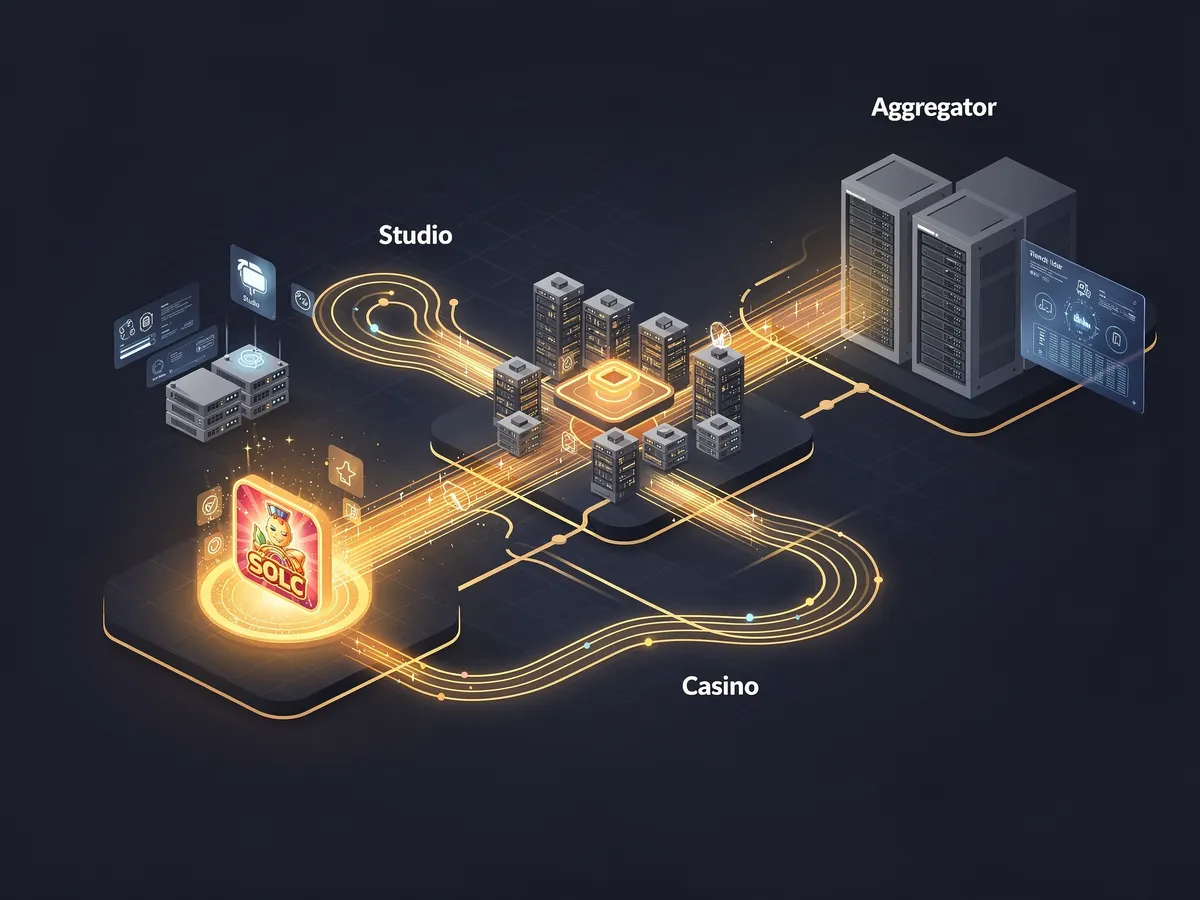
In practice there are two routes. A studio can integrate directly with a casino operator, one contract and one technical build per operator. Or it can integrate once with an aggregator, which then resells that content to dozens or hundreds of operators already connected to its platform. Direct deals give the studio more control and a bigger cut. Aggregated deals give it reach.
Most content you play reaches you through a three-layer chain:
| Layer | Example | What it provides | What it controls |
|---|---|---|---|
| Game studio | Wazdan | The games themselves: art, mechanics, RNG, certified maths models, RTP configurations | Which markets it certifies for, which mechanics it licenses, which partners it signs |
| Aggregator | Games Valley | One API, one contract, one reporting layer covering many studios, plus bonus and data tools | Which studios sit in the catalogue and what the commercial terms are |
| Operator | The casino you log into | The lobby, player accounts, payments, promotions, customer support | Which titles from that catalogue it actually switches on for your region |
Money generally flows backwards along the same chain. The operator pays a revenue share based on the gross gaming revenue a game generates, the aggregator keeps a slice for the platform and the integration, and the studio takes the rest. That split is why distribution strategy is a real commercial decision rather than a formality: a studio trading some margin for an aggregator’s reach is making a bet that volume beats percentage.
What does a game aggregator actually do?
An aggregator is a middleman with an API. Its pitch to an operator is simple: integrate us once and you get hundreds of studios, instead of running hundreds of separate integrations, contracts, certifications and reconciliation processes.
The technical saving is the obvious part. Every direct studio integration means developer time, test cycles, a wallet connection, free-round tooling, reporting fields that need mapping into the operator’s back office, and ongoing maintenance when either side ships an update. Multiply that by 60 studios and a mid-sized casino’s roadmap disappears.
The commercial saving is less visible but matters just as much. One contract, one invoice, one set of game-weighting rules to feed into bonus terms, one compliance conversation about which titles are permitted in which licensed market. Games Valley markets its approach as “Smart Aggregation” and bundles operational tools and data on top of the catalogue, letting operators manage, analyse and optimise the games they run. That is the current direction of travel for the whole aggregation sector: the raw catalogue has become table stakes, so platforms compete on the tooling wrapped around it.
For a studio, a game aggregator partnership is distribution bought wholesale. Wazdan signs one deal and its portfolio becomes available to every operator on that platform that chooses to enable it, which is a far cheaper path to a new region than negotiating site by site.
What does the Wazdan and Games Valley deal actually change?
It widens the pool of operators that can offer Wazdan content without any of them having to build a direct integration with Wazdan. Nothing about the games changes. The route to your screen does.
Which Wazdan games are involved
Wazdan’s catalogue going onto the platform includes titles built around its Hold the Jackpot mechanic, the hold-and-respin style feature the studio is best known for. In that format, collected cash and jackpot symbols lock in place while you get a limited number of respins, each landing symbol resetting the respin counter. It is a high variance structure by design: long stretches of nothing, then a feature round that carries most of the game’s payout weight. Worth saying plainly, since the mechanic gets talked up a lot: a respin feature changes how wins are distributed, not the long-run return. A game’s RTP and its house edge are set by the maths model, whatever the feature does.
Wazdan’s commercial director, Bekki D’Agata, framed the appeal in terms of Games Valley’s technology focus and its aim of helping operators get more out of the content they run, rather than in terms of pure catalogue size. That is a telling emphasis. Studios now care about whether an aggregator’s tooling will actually surface their games in a lobby, not just whether the games are technically available.
Where the reach grows
Aggregated distribution expands reach unevenly, because it only works where the platform already holds operator relationships and market approvals. A studio joining an aggregator inherits that footprint. The practical effect is that players at smaller and mid-sized operators, the ones who were never going to justify a direct Wazdan integration on their own, start seeing those games appear. Large operators with direct studio deals may notice nothing at all.
Why isn’t the same slot available everywhere?
Four reasons, and licensing is the biggest one.
- Market certification. Regulated markets require games to be tested and approved by an accredited lab against local technical standards. A studio has to pay for that per market. Titles that aren’t certified for a jurisdiction legally cannot be served to players there, which is why a lobby can look completely different depending on where you log in from.
- Regional restrictions in the contract. Distribution agreements list permitted territories. An aggregator may hold rights to a studio’s content in some regions and not others, so the same operator brand running two licences can offer two different catalogues.
- Integration and maintenance cost. Every studio an operator connects to consumes technical resource. Smaller operators ration that carefully and lean on one or two aggregators instead.
- Commercial choice. Operators curate. A game with weak retention in their player base gets dropped or never switched on, even though it sits in the catalogue they pay for. Exclusivity windows also exist, where a studio gives one operator first access to a release for an agreed period.
There’s a subtler version of this that affects returns rather than availability. Many studios ship games with more than one certified RTP configuration, and the operator decides which build to deploy. The same slot name at two casinos can therefore run a different long-run return. It’s listed in the game’s info panel, and it’s one of the few genuinely useful numbers to check before you spin.
For players in India, most of this plays out through offshore-licensed operators, which is precisely the segment aggregators serve hardest. If you’ve wondered why two sites that both accept UPI deposits show wildly different slot selections, the answer is usually that they are plugged into different aggregation platforms, not that one has struck some special deal with a studio.
How should players use any of this?
Treat the game library as a feature you check, not something you assume. A few habits that save time:
- Search the lobby before you register. Most casinos let you browse and demo games without an account. If you came for a specific Wazdan title, search it first rather than depositing and hoping.
- Filter by provider. Nearly every lobby has a provider filter. It tells you instantly which studios an operator carries, which is a faster read on its library than any marketing copy.
- Check the RTP in the game info panel. Two lobbies, same title, different configuration. The panel is authoritative; a review page you read last year may not be.
- Read the game weighting in bonus terms. Slots almost always contribute 100% toward a wagering requirement, which is why a bigger slot library is useful when you’re clearing a bonus. It’s the high-RTP table games, blackjack and video poker especially, that typically count for only 10% to 20%, so check the terms before you switch away from the reels.
Wider distribution is genuinely good for variety, and it’s the reason a studio’s back catalogue can suddenly show up at sites that never carried it. What it does not change is the maths. Every slot in those 15,000 titles carries a house edge, the outcome of each spin is independent of the last, and no mechanic or release schedule alters that. Set a deposit limit, treat the spend as entertainment, and use the operator’s limit and cool-off tools if play stops feeling like a choice.